


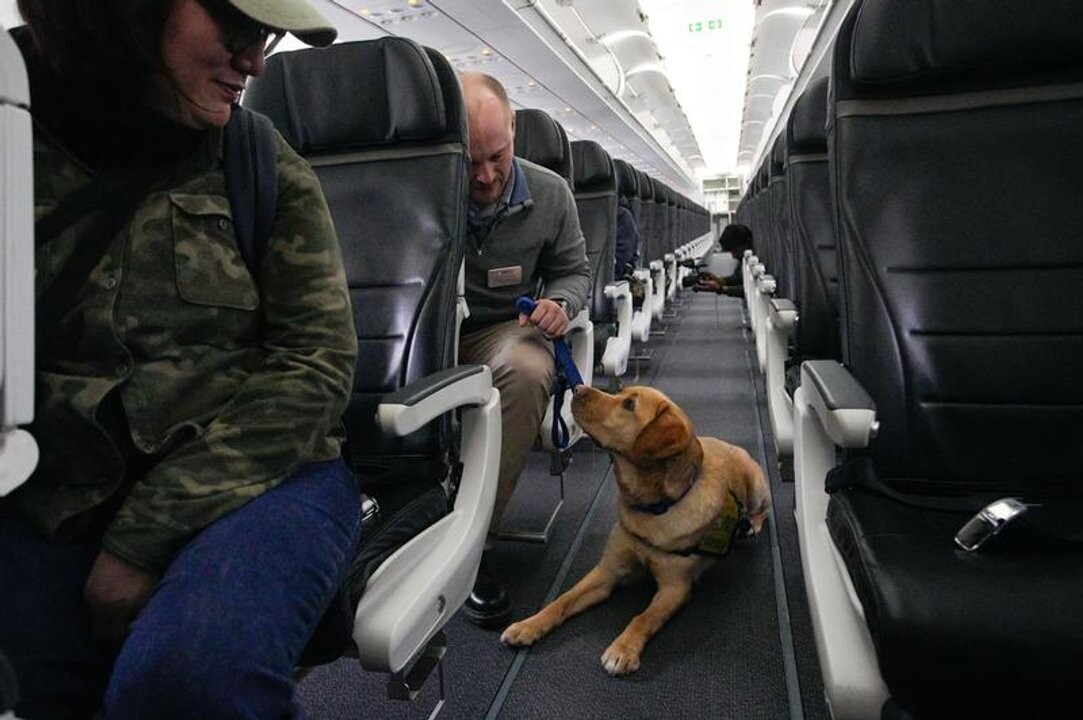
In Richmond, British Columbia, Canada, a service dog was being trained as part of a program. During its preparation, it lay down to rest in the aisle of an airplane at Vancouver International Airport. This stage of training is designed to help the dog confidently assist people with disabilities during travel by familiarizing it with airport environments. The function they are taught is to help reduce stress and face unexpected challenges for future guide dogs, according to Argentine News Agency. Among the thousands of people passing through airport spaces daily, some have a fear of flying, i.e., they suffer from aerophobia. One in three people has it. This fear usually originates from the possibility of having an accident. It is scientifically proven that companion animals, whether dogs or cats, are therapeutic. For example, according to the U.S. National Institutes of Health (NIH), the bond with pets can have a positive impact on health and well-being because they reduce stress, boost mood, alleviate loneliness, and increase opportunities for socialization.
Vancouver Airport For several years, Vancouver International Airport has launched an innovative program aimed at reducing the stress of passengers and employees at the terminal through interaction with dogs. This was the Lower Airport Stress Initiative (LASI), with seven YVR Ambassador Dogs dispersed throughout the airport to help minimize the levels of anxiety and stress in people caused by the proximity of boarding a plane to start a journey, and the hectic work performed by airline and airport terminal staff. These are the factors that easily alter the emotional state of travelers and service staff in any airport in the world.
Air Canada Air Canada has already been accepting emotional support dogs for several years. The animal must be able to travel safely and comfortably in an approved carrier that can be placed under the seat in front of the passenger who is bringing it. If it cannot remain safely and comfortably in a carrier, it may travel in the pressurized baggage compartment available on most aircraft. Each passenger may travel with only one service dog. But there are exceptions: on flights to or from the United States, up to two service dogs may be brought. If necessary, you can purchase an additional space on the cabin floor. The presence of service dogs on seats is not permitted, and they must remain on the floor in front of the passenger who is bringing them for the entire flight.
A condition is that the dog must have been specifically trained to assist a person with a disability. On national, international, and flights to or from the Caribbean, the dog must have completed its training individually with a person or organization specializing in service dog training. The animal must always remain under your control. It must wear a harness, leash, or be tethered, except when it is inside its carrier. You must inform about the dog's size, weight, and other characteristics to assess if it can be comfortably located at your feet. If this is not possible, you can request an additional space on the cabin floor by contacting Air Canada's accessibility services at least 48 hours before the flight. If the company determines that the service dog needs additional space on the floor, it will be offered free of charge on flights within Canada. For all other flights, you will have to purchase this additional space. You must comply with all entry, transit, and exit requirements of the country, province, state, or territory to which you are traveling or from which you depart.
Flights to the U.S. The United States has specific regulations for the entry of dogs into the country. You must complete and send the following forms to Air Canada's accessibility services at least 48 hours before departure: U.S. Department of Transportation form for the air transport of service animals. If the flight is 8 hours or longer, you must also complete the U.S. Department of Transportation's Service Animal Relief Form.