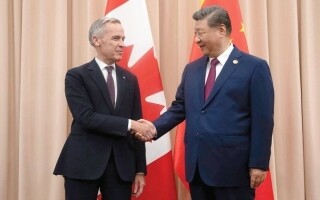
Amid rising global trade barriers, Beijing is determined to keep the export markets its economy depends on open. Mark Carney, a former Goldman Sachs negotiator and central banker in Canada and the UK, confirmed that the long-standing close economic relationship between his country and the US has now ended with US President Donald Trump imposing tariffs and other obstacles. Carney stated that this requires Canada to build deeper relationships with other markets. During his recent visit, Carney told the Chinese President: "Together, we can build on the best of what these relations were in the past to create a new relationship that adapts to the new global reality." However, trade with China will not replace the US as a primary source of growth for Canada. Although Beijing is already Canada's second-largest trading partner, with two-way trade between them reaching about $80 billion in the past 12 months, that figure pales in comparison to the nearly $1 trillion in trade between the US and Canada over the same period. It appears Beijing and Ottawa are ready to solidify relations after years of tensions dating back to 2018, when Canada, at the US's request, arrested a senior Huawei executive, and in response, China detained two Canadians for nearly three years, until 2021, when the US allowed Huawei's chief financial officer, Meng Wanzhou, to return home. Carney is one of the US allies who have recently visited China, following French President Emmanuel Macron's visit in December 2025 and South Korean President Yoon Suk Yeol's earlier this month. Beijing has seized every opportunity to promote its vision of a "world less dominated by Washington," yet its initiatives still face deep skepticism in the West, partly due to China's support for Russia and North Korea. Before Carney's trip, senior Canadian officials tried to temper expectations about its results. They said it was unlikely the two countries would reach an agreement to resolve a trade dispute involving high tariffs on Canadian agricultural products and Chinese electric vehicles. China's ambassador to Canada said Beijing would drop its 76% tariff on canola seeds in exchange for Canada dropping its 100% tariff on Chinese electric vehicles. Carney's office said the two sides signed memoranda of understanding covering energy, crime-fighting, and other issues, providing "the basis for a new strategic partnership." China's massive trade surplus with many Western countries has hindered its efforts to pull them away from the US. Beijing said its global trade surplus hit a record high of about $1.2 trillion last year. Exports to Canada rose slightly more than 3% last year, while China's imports from Canada fell by more than 10%, according to official Chinese data. China seeks to present itself as a force for stability and support for the international system, which is gripped by deep uncertainty from Venezuela to Iran. Canadian Prime Minister Mark Carney has taken a significant step toward revitalizing his country's relations with China and diversifying its trade away from the United States, as Beijing increasingly seeks to court frustrated US allies amid "American protectionism." In a meeting with Carney last Friday at Beijing's Great Hall of the People, Chinese leader Xi Jinping praised the recent shift in relations with the US's northern neighbor. Both sides pointed to opportunities to boost trade in their effort to move beyond years of tensions. Hosting Carney is part of a charm offensive by China, which seeks to position itself as a force for stability and support for the international system, which is experiencing deep uncertainty from Venezuela to Iran.