Canada's political and public mood has shifted noticeably in recent times. Just days ago, the Chief of the Defence Staff, General Jennie Carignan, announced she is seeking Canadians aged 16 to 65 who are ready to help their country in the event of a military attack or a devastating natural disaster. Carignan stated: "We will need heavy equipment operators, drone operators, and we may also need internet specialists." There is no direct link between General Jennie Carignan's plan to form a 400,000-member civilian defense force and U.S. President Donald Trump's actions to oust Venezuelan President Nicolás Maduro from his safe house in Caracas on January 3rd of this year. However, the timing is no coincidence. Last year, Trump repeatedly stated that it is in Canada's interest to become the 51st state of the United States, and no one in a position of responsibility truly believes that the United States will invade Canada. Even Trump himself, when asked if he would use military force to annex Canada, answered "no" or that it was "highly unlikely." However, everyone agrees that the relationship with the United States has changed irreversibly. This change could have been caused by Trump's verbal and economic attacks. Canada had no choice but to attempt to become a nation capable of handling threats independently, whether from its turbulent neighbor or otherwise. Canada is mostly concerned about the actions of Russia and China, cyberattacks, and assaults on infrastructure, but the U.S. raid on Caracas, followed by talk of forcibly acquiring Greenland if necessary, means that military action is no longer out of the question between the two countries that have lived in peace since 1812, before Canada's independence.
Scenario Assessment Canada's Department of National Defence began discussing the creation of a civilian defense force at a time when Trump indicated he would use "economic force" to convince Canadians to join the United States. Mark Carney, the Prime Minister's Chief of Staff, and former Public Safety Minister Marco Mendicino stated: "In this context, it is the government's responsibility to assess all scenarios and options, including the creation of a voluntary civilian defense force that can support the Canadian Armed Forces." Meanwhile, Canada's Department of National Defence has developed some of these scenarios, and the plans are now regularly updated to handle a potential influx of migrants wishing to enter Canada from the United States. Trump's preference for sending troops to states run by Democrats and using the Department of Justice to prosecute political opponents has pushed Canada to prepare for a possible civil conflict on its doorstep. Military planners have also developed scenarios where an adversary like Russia or China attacks Canadian infrastructure or cuts off energy or water supplies to paralyze the movement of American military forces while one of these adversaries attacks the Baltic states or Taiwan. General Carignan says Canada is constantly under cyberattack and adds reassuringly, "We are always preparing for the worst-case scenario." However, officials are not keen on discussing all these matters, and it's entirely logical that they don't want to give potential adversaries any hints about Canada's preparations or its weak points. But they are also occupied with trying not to provoke Trump, and few of them are willing to give recorded interviews. But the truth is that the worst-case scenarios, however unlikely their occurrence, now include an invasion from America.
General Carignan says the plan to mobilize a civilian defense force must satisfy the United States, as it meets Trump's demand that America's allies take more responsibility for their own defense and rely less on the United States in the event of an attack or natural disaster. In November 2025, she sent a team to Finland to study the comprehensive civil defense system that Helsinki has developed over decades of threats from its neighbor Russia.
Trained Civilians Under their comprehensive security concept, Finns are expected to store enough food, water, and medical supplies for 72 hours. Lists are kept of civilians trained in first aid, rescue, and firefighting who will lead others to designated bomb shelters spread across the country. These shelters are large enough to accommodate 85% of Finns. They are not dull doomsday bunkers; they include underground sports halls and saunas. Canadians are impressed by this. One official said, "They have shelters everywhere, and they make them ordinary places, some have swimming pools." However, it is also noted that Canada is 30 times larger than Finland, with vast tracts of land with low population density, where it is almost impossible to defend sovereignty without American help. The Prime Minister's Chief of Staff in Canada wants to change this and has pledged to spend $59 billion U.S. over the next five years so that Canada is on track to allocate 5% of its GDP to defense by 2035. Most of this money will be spent in northern Canada, where Russian submarines and Chinese 'research' vessels are increasingly invading Canadian Arctic waters. Carignan says, "There is a threat coming from the north, and we cannot just be a burden."
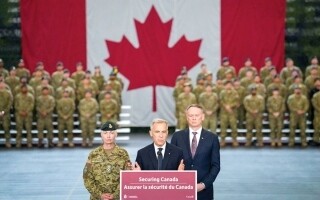
Strengthening Defense The Canadian Armed Forces consist of 67,000 full-time personnel and 27,000 reservists, all of whom have joined voluntarily. In addition to defending the second-largest country in the world, they are operating at their limits in long-range operations. In Latvia, they are bolstering the defense of the Baltic states, while a naval mission is keeping the Taiwan Strait open for international navigation. These armed forces are spread over an area of about 10 million square kilometers in Canada. Climate change may have slipped down the country's list of priorities, but the damage from increasingly dangerous weather has not disappeared. The military is regularly called upon to assist people affected by floods and forest fires. In 2020, when the 'coronavirus' virus hit long-term care homes, which were severely short-staffed in Ontario and Quebec, the army was sent to care for them. A new civilian defense force could help in such emergencies, freeing up the army to focus on the actual defense of the nation.
Source: "The Economist"
Canadians Are Waking Up Canadians may be starting to wake up from the slumber they have enjoyed since defense spending first fell below 2% of GDP more than three decades ago. It seemed that no one was bothered by Canada's reliance on the United States for most of its regional defense. Philip Lagassi, who studies defense at Carleton University in Ottawa, notes that Canada has never faced threats like those it faces today. He says, "The Canadian mind has difficulty grasping the new reality." It appears that Canadians are beginning to wake up, likely due to the ambitions of U.S. President Donald Trump. The Chief of the Defence Staff, General Jennie Carignan, says she is seeing a steady stream of Canadians willing to serve. Before Christmas, an elderly man urged her to give him a task, despite his age. He told her, "Listen, I can't take up a rifle and go to war, but I can help. Tell me how I can do that." • The Canadian Armed Forces consist of 67,000 full-time personnel and 27,000 reservists.